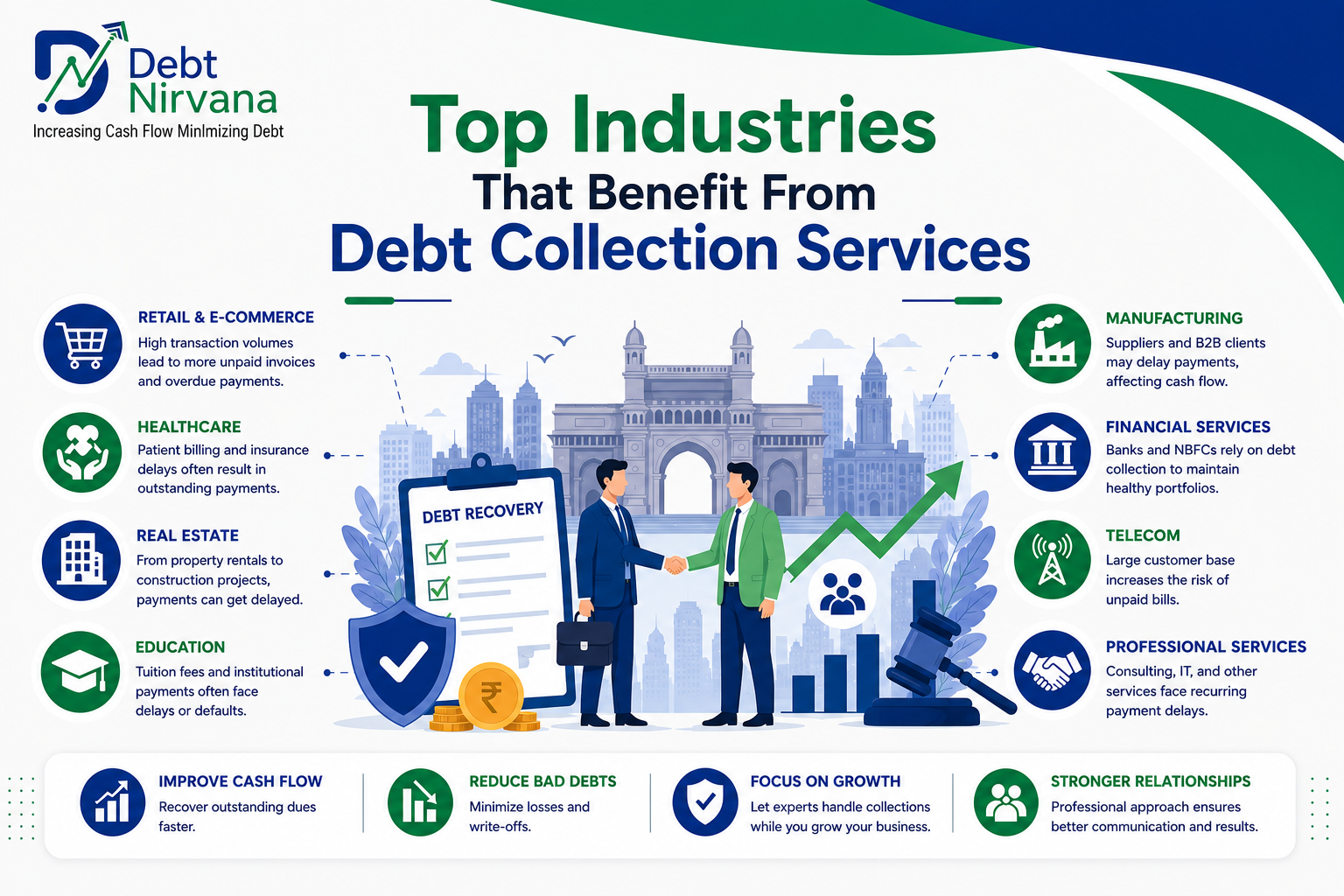

Top Industries That Benefit From Debt Collection Services
Unpaid dues don’t just hurt cash flow. They pile up quietly until a business realizes too much money is sitting with people who never plan to pay on time. That’s why a debt collection service isn’t just for banks anymore. Industries ranging from healthcare to real estate now rely on structured recovery support to keep […]
Unpaid dues don’t just hurt cash flow. They pile up quietly until a business realizes too much money is sitting with people who never plan to pay on time.
That’s why a debt collection service isn’t just for banks anymore. Industries ranging from healthcare to real estate now rely on structured recovery support to keep receivables moving.
This article looks at which sectors benefit the most, why their collection needs differ, and what a good debt collection service India actually handles for each one.
Table of Contents
- Why Debt Collection Needs Vary by Industry
- Banking, NBFCs, and Financial Services
- Healthcare
- Real Estate and Construction
- Manufacturing and B2B Trade
- Retail and E-Commerce
- Telecom and Utilities
- Education
- Comparing Collection Needs Across Industries
- FAQ
- Key Takeaways
Why Debt Collection Needs Vary by Industry
Every industry deals with overdue payments differently, depending on ticket size, borrower type, and how regulated the sector is.
A bank recovering an EMI default follows different rules than a hospital recovering a patient’s unpaid bill. A construction firm chasing a client follows a completely different process than a telecom company recovering unpaid subscriptions.
Because of that, no single collection approach works everywhere. The industries below show just how differently recovery plays out depending on who owes the money and why.
Banking, NBFCs, and Financial Services
Banks and NBFCs remain the largest users of debt collection services in India, simply because lending is their core business.
According to the RBI’s Financial Stability Report from June 2026, gross NPAs across banks fell to a multi-decadal low of 1.8% as of March 2026, with capital and liquidity buffers remaining strong across banks, NBFCs, and insurers. That’s good news overall, but it doesn’t mean recovery pressure has disappeared.
The same RBI data reported by Business Standard shows stressed assets in the NBFC microfinance segment rose to 5.9% in March 2025, up from 3.9% in September 2024, with write-offs among upper layer NBFCs surging to 72.9% in March 2025, compared to roughly 50% in June 2022. Small-ticket personal loans have been a particular pressure point.
Why This Sector Needs Specialized Collection Support
Financial institutions face strict conduct rules that other industries don’t. Elision Technologies’ overview of TRAI’s 1600-series numbering mandate explains that, directed in November 2025, banks and NBFCs must now route collection calls through dedicated, identifiable number series rather than standard 10-digit numbers, with commercial banks required to comply from January 1, 2026, and large NBFCs, payment banks, and small finance banks from February 1, 2026.
This means a debt collection service working with banks and NBFCs has to combine recovery skill with strict regulatory compliance, not just persistence.
Healthcare
Healthcare is one of the biggest, and least talked about, users of debt collection services globally.
According to Valuates Reports’ market study on India’s debt collection services sector, healthcare is one of the largest application areas, alongside student loans, financial services, retail, telecom, utilities, and mortgages, accounting for close to 30% of total demand.
Hospitals and diagnostic centers routinely treat patients before full payment is confirmed, especially in emergencies. That creates a steady stream of partial or delayed payments that need structured follow-up, ideally handled with sensitivity rather than aggressive tactics.
What Makes Healthcare Collection Different
Unlike a loan default, a medical bill often involves emotional and financial stress at the same time. A good collection process here focuses on flexible repayment plans rather than blunt demands, since the goal is recovering dues without damaging the patient relationship.
Real Estate and Construction
Real estate and construction generate some of the largest unpaid amounts per case, simply because project values are high.
According to IndiaMart’s directory of debt recovery service providers, real estate and construction are commonly listed among core client industries served by Indian debt recovery firms, alongside manufacturing, trading, and IT and telecom services.
Builders often deal with buyers who default on installment payments, or contractors left waiting on final settlements after project completion. These cases can involve six or seven-figure amounts, making early intervention critical.
Common Recovery Triggers in This Sector
- Delayed installment payments from buyers
- Disputed final settlements with contractors
- Unpaid dues from commercial tenants
- Cheque bounce cases tied to project payments
Manufacturing and B2B Trade
Manufacturers and trading businesses deal with a very specific kind of debt: unpaid invoices between businesses.
This is B2B debt, governed less by consumer protection rules and more by contract law, the MSMED Act, and commercial dispute resolution. Manufacturing and trading are consistently listed among the top industries served by professional debt recovery firms in India, according to the same IndiaMart industry listing.
Since one late payment often triggers a chain reaction across suppliers, this sector benefits heavily from fast, structured intervention rather than waiting months for informal reminders to work.
Retail and E-Commerce
Retail and e-commerce collection looks different again, since it usually involves a high volume of smaller unpaid amounts rather than a few large ones.
Retail is specifically named as one of the key application segments in India’s debt collection services market data from Valuates Reports, alongside telecom and utilities. Buy-now-pay-later defaults, unpaid credit purchases, and returned-goods disputes all fall into this space.
Because volume is high and individual amounts are often small, this sector relies heavily on automated reminders, digital payment links, and scaled outreach rather than manual case-by-case handling.
Telecom and Utilities
Telecom and utility providers deal with a mix of postpaid bill defaults and unpaid service charges across a very large customer base.
Telecom and utility services appear directly in industry breakdowns of India’s debt collection market, reflecting how widespread unpaid subscriptions and bills are across this sector.
Given the sheer customer volume involved, telecom recovery leans on automated multi-channel outreach, SMS, WhatsApp, and calls, combined with strict adherence to communication-timing rules.
Education
Education has grown into a meaningful collection category, largely driven by the rise of student loans and ed-tech financing.
Student loans are explicitly tracked as a separate application category in India’s debt collection services market research, distinct from broader financial services.
This includes tuition financing defaults, EMI-based course payments, and institutional dues from students who’ve discontinued programs. Recovery here often needs a longer, more patient timeline, since repayment capacity can shift significantly for young borrowers early in their careers.
Comparing Collection Needs Across Industries
Here’s a side-by-side look at how collection priorities shift across sectors.
| Industry | Typical Debt Type | Collection Priority |
| Banking & NBFCs | Loan EMIs, credit card dues | Regulatory compliance, structured field recovery |
| Healthcare | Unpaid medical bills | Sensitive, patient-friendly follow-up |
| Real Estate & Construction | Installments, contractor dues | High-value case management, legal escalation |
| Manufacturing & B2B Trade | Unpaid invoices | Fast intervention, contract-based recovery |
| Retail & E-Commerce | BNPL defaults, credit purchases | High-volume, automated outreach |
| Telecom & Utilities | Unpaid bills, subscriptions | Scaled, multi-channel communication |
| Education | Tuition, course EMIs | Flexible, longer-term repayment plans |
This is exactly why choosing a Debt Collection Service India with sector-specific experience matters more than picking the cheapest option available.
FAQ
Which industries use debt collection services the most in India?
Banking and NBFCs remain the largest users, followed closely by healthcare, retail, telecom, real estate, and education.
Why does healthcare need debt collection support?
Hospitals often treat patients before payment is finalized, especially in emergencies, which creates ongoing partial or delayed payment cases that need structured, sensitive follow-up.
Is debt collection different for B2B businesses compared to consumer lenders?
Yes. B2B collection relies on contract law and commercial dispute resolution, while consumer lending follows RBI’s Fair Practices Code and strict communication rules.
Do small businesses benefit from debt collection services too?
Yes, especially manufacturers and traders dealing with unpaid invoices, where delayed payments can disrupt an entire supplier chain.
How does telecom debt collection differ from bank debt collection?
Telecom collection usually involves a high volume of smaller unpaid bills, so it relies more on automated, multi-channel outreach than manual case handling.
Are debt collection rules the same across all industries?
No. Regulated sectors like banking and NBFCs follow strict RBI and TRAI communication rules, while B2B and real estate collection follows contract and civil law instead.
What should a business look for in a debt collection service?
Sector-specific experience, compliance awareness, and a recovery approach suited to the size and nature of typical unpaid amounts in that industry.
Key Takeaways
- Debt collection needs differ significantly by industry, based on ticket size, borrower type, and regulation.
- Banking and NBFCs remain the largest users, but healthcare, retail, and telecom are close behind.
- B2B sectors like manufacturing and real estate need contract-based, high-value recovery strategies.
- Regulated sectors like banking face strict RBI and TRAI compliance requirements around collection calls.
- Choosing a debt collection service India with relevant sector experience improves recovery outcomes.
Conclusion
Debt collection isn’t a one-size-fits-all service. What works for a bank recovering an EMI default won’t work for a hospital following up on a patient bill, or a builder chasing a delayed installment.
Understanding these differences helps businesses across every sector recover dues faster and with less friction. If your industry is dealing with rising overdue payments, working with an experienced Debt Collection Service India or a trusted Debt Collection Agency can help you build a recovery process suited to your specific business.