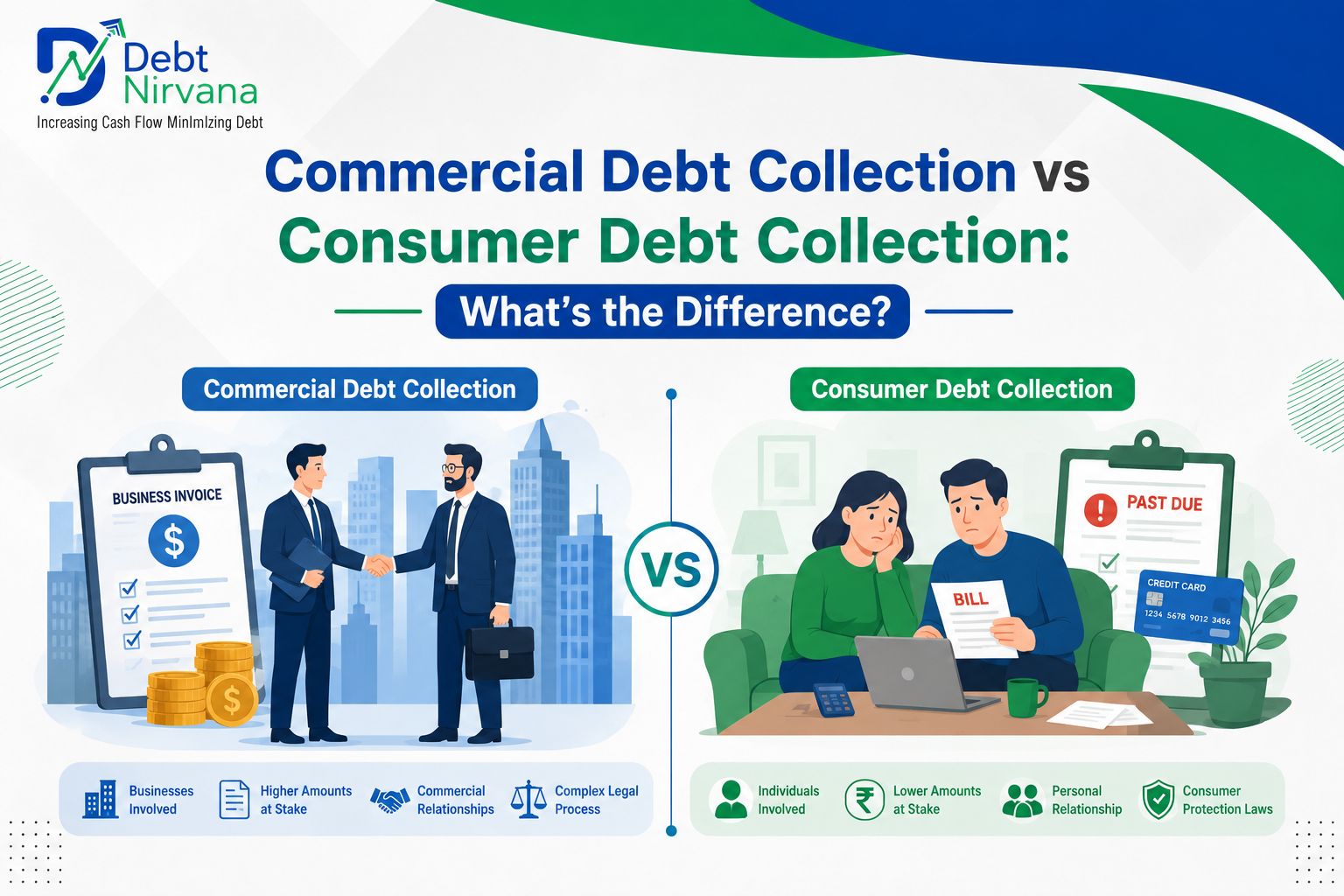

Commercial Debt Collection vs Consumer Debt Collection: What’s the Difference?
If a client owes you ₹8 lakh on an unpaid invoice, the recovery process looks nothing like what happens when a bank chases someone over a missed credit card payment. Commercial debt collection deals with money owed between businesses. Consumer debt collection deals with money owed by individuals, usually to banks, NBFCs, or lenders. For […]
If a client owes you ₹8 lakh on an unpaid invoice, the recovery process looks nothing like what happens when a bank chases someone over a missed credit card payment.
Commercial debt collection deals with money owed between businesses. Consumer debt collection deals with money owed by individuals, usually to banks, NBFCs, or lenders.
For a business owner trying to recover dues, knowing which category your situation falls into changes everything: which laws apply, which forum you approach, and how fast you can realistically expect payment. This guide breaks down both, so you can choose the right recovery path.
What Is Commercial Debt Collection?
Commercial debt collection is the process of recovering money owed between businesses, typically unpaid invoices, purchase orders, or service contracts.
It usually involves a supplier chasing a buyer, or a vendor chasing a client, for dues tied to a commercial transaction. There’s no consumer protection framework here, because both sides are treated as business entities.
A commercial debt collection service handles this end to end: sending demand notices, negotiating settlements, and escalating to arbitration or commercial courts if needed.
Who Uses Commercial Debt Collection?
This applies to a wide range of businesses, including:
- Manufacturers waiting on payment from distributors
- IT and service providers chasing corporate clients
- MSME suppliers dealing with delayed buyer payments
- Contractors and vendors owed dues on completed projects
What Is Consumer Debt Collection?
Consumer debt collection involves recovering money owed by individual borrowers, usually for personal loans, credit cards, or retail financing.
Here, one party is always an individual consumer, and the other is typically a bank, NBFC, or lending platform. This distinction matters legally, because consumers get protections businesses don’t.
A debt collection service India offering consumer recovery must follow strict conduct rules that don’t apply to B2B collection at all.
Key Differences Between Commercial and Consumer Debt Collection
The table below summarizes how the two differ in practice.
| Aspect | Commercial Debt Collection | Consumer Debt Collection |
| Parties involved | Business to business | Lender to individual borrower |
| Governing framework | Contract law, MSMED Act, Commercial Courts Act | RBI Fair Practices Code, SARFAESI Act |
| Typical amount | Often larger, tied to invoices or contracts | Often smaller, tied to EMIs or credit card dues |
| Regulatory oversight | Minimal; courts and arbitration handle disputes | Heavy oversight by RBI on agent conduct |
| Communication rules | No fixed statutory calling hours | Contact restricted to 8 AM–7 PM under RBI rules |
| Resolution forums | Commercial courts, arbitration, MSME Samadhaan, IBC | Consumer courts, RBI Ombudsman, DRTs |
| Consumer protection laws | Not applicable | Applicable, since borrower is an individual |
Understanding this table helps explain why the legal strategy for chasing a corporate client looks completely different from recovering a personal loan default.
Laws That Govern Commercial Debt Recovery in India
Commercial recovery in India runs through a mix of contract enforcement mechanisms rather than a single consumer-style code.
The MSMED Act, 2006
If you’re a registered micro or small enterprise, the Micro, Small and Medium Enterprises Development Act gives you real leverage. Under Section 15, a buyer must pay within the period agreed in writing, capped at a maximum of 45 days from acceptance of goods or services.
Miss that deadline, and Section 16 kicks in. According to Debitura’s overview of debt collection in India, the buyer becomes liable for compound interest at three times the RBI’s bank rate on the delayed amount.
You can also file a dispute through the MSME Samadhaan portal, referred to the Micro and Small Enterprises Facilitation Council. The same Debitura analysis notes the council must attempt conciliation and, failing that, arbitration, deciding the matter within 90 days, with the resulting award enforceable like a court decree.
One catch worth knowing: as DCorpo Legal’s review of MSME Samadhaan cases explains, only enterprises engaged in manufacturing or services qualify as MSMEs under this Act, and pure trading businesses are not entitled to file under MSME Samadhaan.
The Commercial Courts Act, 2015
For disputes above a certain value, Legal Advocate Online’s guide to recovery notices notes that the Commercial Courts Act allows disputes worth ₹3 lakh or more to be filed in a commercial court, which follows a summary procedure designed for faster disposal than regular civil courts.
This route works well when there’s no MSME registration involved, or when the claim amount is too large for informal settlement.
The Insolvency and Bankruptcy Code (IBC)
For larger, unresolved commercial defaults, LegalFund’s guide on recovering outstanding payments points out that operational creditors can initiate insolvency proceedings against a defaulting company under Section 9 of the IBC, which often creates significant settlement pressure even before the case proceeds far.
This isn’t meant for every unpaid invoice. It works best when the debtor company shows signs of broader financial distress.
The Limitation Act, 1963
Timing matters more than most business owners realize. As LexWorth Law explains, if a debt claim isn’t enforced within the limitation period, the right to recover it through legal action can be lost, even if the dues themselves are genuine.
The good news: the same LexWorth Law analysis notes that if the debtor acknowledges the debt in writing and signs it before the limitation period expires, Section 18 of the Act effectively restarts the clock. This is why collecting written acknowledgments early is a core part of any solid recovery strategy.
Laws That Govern Consumer Debt Recovery in India
Consumer-facing collection is far more tightly regulated, because the individual borrower is assumed to have less bargaining power than a lender.
RBI’s Fair Practices Code
As Freed’s overview of the 2026 RBI recovery agent rules explains, the RBI’s Fair Practices Code sets rules for how banks and NBFCs can collect overdue consumer debt, covering the timing of calls, the language agents can use, and how they must conduct themselves during recovery visits.
A major update tightened this further in 2026. According to SingleDebt Business’s coverage of the update, recovery agents may only contact borrowers between 8 AM and 7 PM, and any contact outside those hours is treated as a violation of the Fair Practices Code.
Lending institutions are now directly and solely responsible for their agents’ conduct, meaning any use of abusive language or privacy violations by an agent results in consequences falling on the bank itself.
The SARFAESI Act, 2002
For secured retail loans like home or vehicle loans, Khanna & Associates’ guide on recovery agent rights notes that the SARFAESI Act governs recovery of secured assets, and banks must issue a 60-day notice before taking possession, with borrowers retaining the right to respond and appeal.
Consumer Protection Remedies
Individual borrowers facing harassment can approach consumer courts, file complaints with the RBI Ombudsman, or in serious cases, invoke provisions under the Indian Penal Code for intimidation or threats.
None of these consumer-specific protections apply when the debtor is a business. That’s the core reason commercial and consumer collection can’t be handled the same way.
Which Recovery Route Should a Business Choose?
If you’re a business owed money by another business, here’s a simple way to think about it:
- Check if you qualify as an MSME. If yes, MSME Samadhaan is often the fastest, lowest-cost route.
- Check the claim value. Above ₹3 lakh with no MSME angle, a commercial court may suit better.
- Check the contract. If there’s an arbitration clause, that likely takes precedence over civil litigation.
- Check the debtor’s financial health. If they show signs of insolvency, IBC proceedings can apply real pressure.
- Check your limitation window. Don’t let a valid claim expire; get written acknowledgment if a resolution is taking time.
Common Mistakes Businesses Make During Commercial Recovery
A few patterns show up again and again in delayed B2B recovery cases.
- Waiting too long before sending a formal demand notice
- Not documenting delivery, acceptance, or written confirmations early
- Assuming trading businesses get MSME protection when they don’t
- Missing the arbitration notice requirement when a clause exists
- Letting the limitation period lapse without securing an acknowledgment
Avoiding these mistakes early usually shortens the entire recovery timeline.
FAQ
What is the main difference between commercial and consumer debt collection?
Commercial collection involves business-to-business dues under contract law, while consumer collection involves individual borrowers protected by RBI conduct rules.
Does the RBI Fair Practices Code apply to commercial debt collection?
No. It applies specifically to lenders recovering from individual consumers, not to B2B recovery between businesses.
Can an MSME use the Samadhaan portal for any unpaid invoice?
Only if the business is registered as a micro or small enterprise engaged in manufacturing or services. Trading businesses are excluded.
What happens if a buyer doesn’t pay within 45 days under the MSMED Act?
The buyer becomes liable for compound interest at three times the RBI’s bank rate on the delayed amount.
Is there a time limit to recover a business debt in India?
Yes. Under the Limitation Act, claims generally must be enforced within a set period, though a written acknowledgment from the debtor can restart that clock.
Can a business use insolvency proceedings to recover an unpaid invoice?
Yes, if the amount qualifies and the debtor shows signs of financial distress, operational creditors can file under Section 9 of the IBC.
When should a business consider a commercial debt collection service instead of handling recovery internally?
When informal reminders fail, the amount is significant, or the debtor is unresponsive, professional recovery support can move things faster than in-house follow-ups.
Are consumer loan recovery agents allowed to call anytime?
No. Under RBI rules, agents can only contact borrowers between 8 AM and 7 PM.
Key Takeaways
- Commercial debt collection deals with business-to-business dues; consumer collection deals with individual borrowers.
- MSME suppliers get strong legal leverage under the MSMED Act, including compound interest on delayed payments.
- Consumer collection is far more regulated, with strict RBI rules on agent conduct and communication timing.
- Choosing the right recovery forum, MSME Samadhaan, commercial court, arbitration, or IBC, depends on claim size, contract terms, and debtor status.
- Acting early and documenting acknowledgments protects your legal right to recover dues before limitation periods expire.
Conclusion
Commercial and consumer debt collection follow completely different rulebooks. One is built around contracts, invoices, and business law. The other is built around consumer protection and lender accountability.
Knowing which one applies to your situation saves time and prevents costly missteps. If your business is dealing with unpaid invoices, working with an experienced commercial debt collection service can help you choose the right recovery path and move faster toward payment.