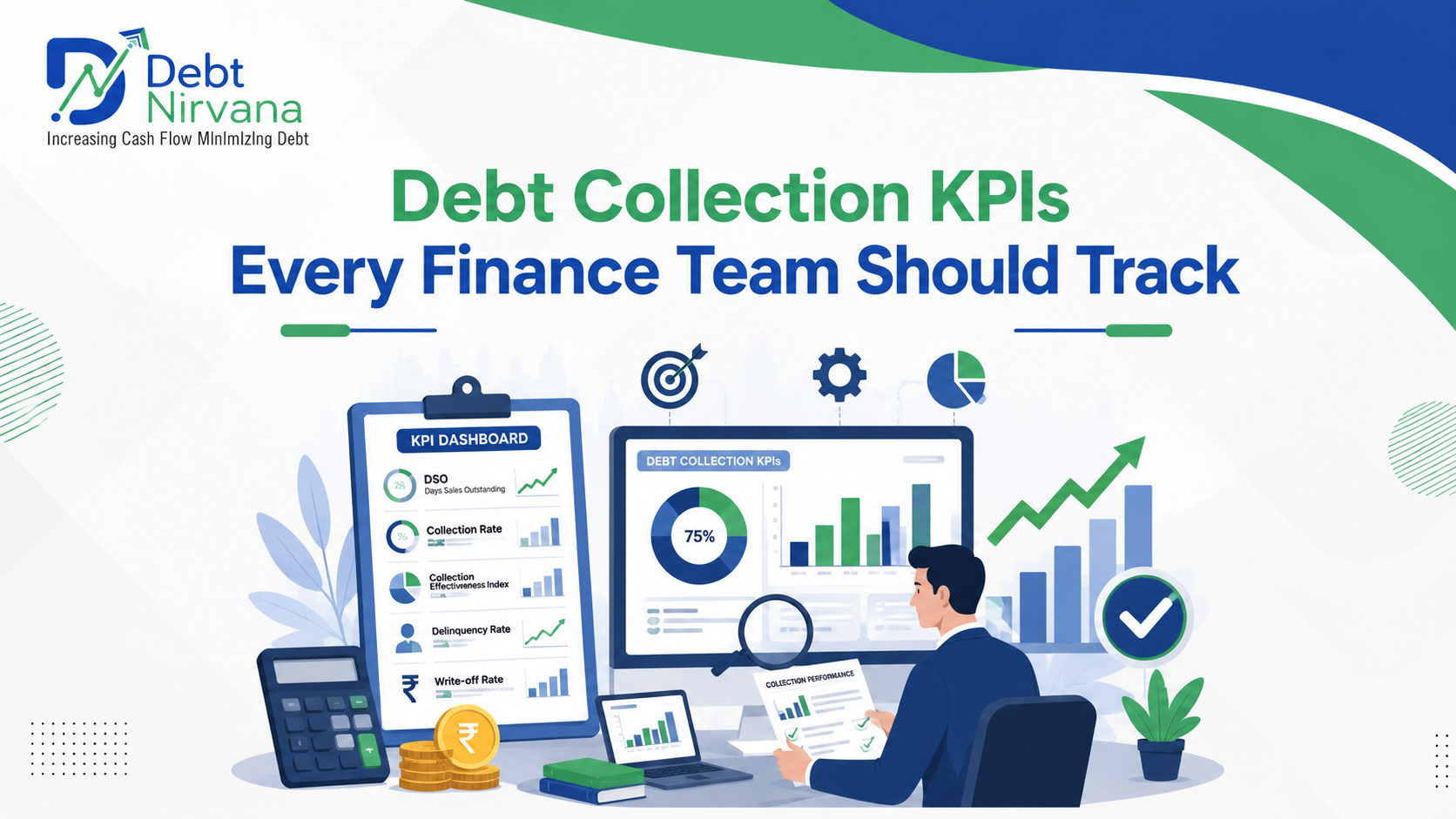

Debt Collection KPIs Every Finance Team Should Track
A finance team that only checks how much cash came in this month is flying half-blind. The real story is in the numbers behind that number. Debt collection KPIs tell you whether your collections process is actually working, or just getting lucky some months and unlucky in others. This guide covers the KPIs that matter […]
A finance team that only checks how much cash came in this month is flying half-blind. The real story is in the numbers behind that number.
Debt collection KPIs tell you whether your collections process is actually working, or just getting lucky some months and unlucky in others.
This guide covers the KPIs that matter most, what healthy benchmarks look like, and when the data tells you it’s time to bring in a debt collection company instead of stretching your internal team further.
Why Debt Collection KPIs Matter
Collections without KPIs is guesswork. You might feel like collections are going fine, right up until cash flow tightens with no warning.
KPIs turn that vague feeling into a number you can track weekly or monthly. That number tells you exactly where the process is breaking down, whether it’s slow follow-up, weak dialing data, or accounts sitting too long before escalation.
As ARDEM’s 2026 breakdown of accounts receivable KPIs puts it, these metrics help CFOs monitor collections efficiency and working capital performance, rather than reacting only after cash flow problems show up.
Days Sales Outstanding (DSO)
DSO measures the average number of days it takes your company to collect payment after a sale.
According to KPI Depot’s 2026 credit and collections benchmarks, DSO gauges how quickly billed revenue converts into cash, and acts as an early barometer of liquidity risk. A rising DSO often signals tighter working capital ahead.
Benchmarks vary by industry, but Business Debt Collection KPIs’ 2026 profile notes that high-performing companies typically maintain DSO below 45 days, while companies dealing with chronic late payers often see it climb past 60 to 70 days.
Track DSO monthly, and compare it against your standard payment terms. A DSO far higher than your terms is the clearest early sign collections need attention.
Collection Effectiveness Index (CEI)
CEI measures what percentage of collectible receivables your team actually collected during a given period.
Unlike DSO, which can be skewed by sales timing, CEI focuses purely on collection performance. Business Debt Collection KPIs’ profile states that a CEI above 90% is generally considered efficient, and the metric is gaining traction as a real-time performance barometer across industries with varying payment cycles.
A more conservative benchmark comes from Viaante’s 2026 review of top accounts receivable KPIs, which suggests best-in-class finance teams target a CEI of 80% or higher, with anything below 75% typically pointing to inconsistent follow-up or weak collections workflows.
The gap between these two numbers is worth noting. Either way, tracking CEI alongside DSO gives a fuller picture than either metric alone.
Accounts Receivable Aging Distribution
Aging distribution breaks your outstanding receivables into time buckets, like 0 to 30 days, 31 to 60, 61 to 90, and 90-plus.
As ARDEM’s accounts receivable KPI guide explains, aging distribution remains one of the most essential AR metrics because it reveals the risk profile of your receivables and helps predict future write-off risk before it happens.
A growing share of receivables in the 90-plus bucket is one of the earliest warning signs that informal reminders aren’t working anymore.
Average Days Delinquent (ADD)
ADD measures how many days, on average, payments arrive after their due date, not after the invoice date like DSO.
This distinction matters. The ARDEM KPI guide notes that a company with 60-day payment terms may show a high DSO but a low ADD, which simply means customers are paying on schedule. A high ADD, on the other hand, signals systemic payment delays regardless of your credit terms.
Tracking DSO and ADD together helps finance teams tell the difference between generous credit terms and an actual collections problem.
Bad Debt Percentage
This is the share of total receivables ultimately written off as uncollectible.
According to Centime’s overview of collection performance metrics, bad debt percentage helps identify areas of concern in credit control and collections, and points to where corrective action is most needed.
A rising bad debt percentage, especially alongside a growing 90-plus aging bucket, is usually the clearest signal that internal collections efforts have run their course on certain accounts.
Right Party Contact Rate (RPC)
RPC measures how often your team actually reaches the person responsible for paying, not a wrong number, gatekeeper, or voicemail.
As inConcert’s 2026 breakdown of debt collection KPIs explains, RPC reflects the health of your contact database and the intelligence of your dialing strategy. A low RPC rate usually means it’s time to review contact timing or clean up outdated data.
This KPI is often overlooked, but it directly affects every other number on this list. You can’t collect from someone you never actually reach.
Promise-to-Pay (PTP) Kept Rate
A promise to pay is only useful if it’s actually kept. This KPI tracks what percentage of payment promises are fulfilled.
The same inConcert analysis points out that getting the promise only gets you halfway there. A low kept rate usually means agents are accepting unrealistic agreements under pressure to close the interaction, rather than agreements the customer can actually follow through on.
Tracking this separately from your overall recovery rate helps you spot whether agents are chasing easy wins that don’t actually convert to cash.
Cost to Collect
This measures how much it costs your business, in staff time, tools, and overhead, to recover a given amount of overdue debt.
A low DSO and high CEI don’t mean much if the cost of achieving them is eating into the recovered amount. This is especially important when comparing in-house collection against outsourcing to a specialized debt collection company.
As accounts age and require more manual follow-up, cost to collect typically rises sharply, which is one reason early intervention tends to be more cost-effective than waiting.
KPI Benchmarks at a Glance
Here’s a quick reference for the KPIs covered above.
| KPI | What It Measures | Healthy Benchmark |
| DSO | Average days to collect payment after a sale | Below 45 days |
| CEI | Percentage of collectible receivables actually collected | 80% or higher |
| Aging Distribution | Share of receivables in each overdue time bucket | Minimal balance in 90+ days |
| ADD | Average days payment arrives past the due date | Close to zero |
| Bad Debt % | Share of receivables written off as uncollectible | As low as possible, trending down |
| RPC Rate | How often the right person is actually reached | High and stable over time |
| PTP Kept Rate | Share of payment promises actually fulfilled | High, not just high PTP volume |
No single KPI tells the whole story. A rising DSO paired with a falling CEI is a much stronger warning sign than either metric alone.
When to Bring in a Debt Collection Company
KPIs aren’t just for monitoring. They should also guide the decision to escalate.
- DSO consistently exceeds your payment terms by 15 or more days
- CEI has dropped below 75% for two or more consecutive periods
- A growing share of receivables sits in the 90-plus aging bucket
- RPC rate is falling despite consistent outreach attempts
- Internal cost to collect is rising faster than amounts recovered
When two or more of these signals show up together, it’s usually a sign that internal follow-up has hit its limit for those accounts.
At that point, working with an experienced Debt Collection Company India can bring in the structured escalation, negotiation, and legal expertise that internal teams typically aren’t built to handle at scale.
FAQ
What is the most important debt collection KPI to track?
DSO and CEI are usually considered the two most important, since tracked together they show both how fast you’re collecting and how effectively.
What is a good Collection Effectiveness Index?
Most benchmarks place a strong CEI at 80% or higher, with some sources considering 90% and above as highly efficient.
What’s the difference between DSO and Average Days Delinquent?
DSO measures days from the invoice date to payment, while ADD measures days from the due date to payment, which better isolates true payment delays.
Why does Right Party Contact rate matter in debt collection?
If your team can’t reach the actual person responsible for paying, every other KPI in the process suffers, since no promise or payment can happen without contact.
How often should finance teams review these KPIs?
Monthly is standard for most metrics, though DSO and aging distribution are often useful to review weekly during periods of rising overdue balances.
When should a business bring in a debt collection company?
When key KPIs like DSO, CEI, and aging distribution show sustained decline together, rather than a single off month, it’s usually time to bring in outside support.
Does a high Promise-to-Pay rate always mean good collections performance?
Not on its own. A high PTP rate with a low kept rate often signals agents are accepting unrealistic promises rather than collecting real payments.
Key Takeaways
- DSO and CEI together give the clearest picture of collections speed and effectiveness.
- Aging distribution and Average Days Delinquent help distinguish generous credit terms from real payment problems.
- Right Party Contact rate and Promise-to-Pay kept rate reveal issues that headline numbers often hide.
- Cost to collect matters as much as recovery speed, especially when comparing in-house effort to outsourcing.
- Sustained decline across multiple KPIs, not just one bad month, is the clearest signal to escalate to a debt collection company.
Conclusion
Debt collection KPIs turn a vague sense of “collections could be better” into specific, trackable numbers finance teams can act on.
Tracking DSO, CEI, aging distribution, and the other metrics above helps you catch problems early, before they turn into serious cash flow strain. If your KPIs are trending in the wrong direction, partnering with an experienced Debt Collection Company India can help bring those numbers back under control.