
How to Choose the Right Debt Collection Agency in India: A Checklist for Businesses
An unpaid invoice is more than a line on your ageing report. It is working capital that should be funding payroll, inventory and growth. When reminders, calls and escalations stop working, many businesses bring in a debt collection agency. India has no shortage of agencies, and that is the problem. They differ widely in the […]
An unpaid invoice is more than a line on your ageing report. It is working capital that should be funding payroll, inventory and growth. When reminders, calls and escalations stop working, many businesses bring in a debt collection agency.
India has no shortage of agencies, and that is the problem. They differ widely in the debts they handle, the methods they use and how they treat your customers. Choose badly and you can lose the debt, the client relationship and some of your reputation.
This checklist explains how to choose the right debt collection agency in India. It covers what to look for, what to ask before you sign, and the warning signs that should make you walk away. It is written for businesses recovering commercial (B2B) dues, such as unpaid invoices, bounced cheques, and outstanding payments from distributors, dealers and corporate clients.
When Should a Business Hire a Debt Collection Agency?
There is no fixed rule. But these situations usually mean in-house follow-up has run its course:
- The invoice is well past its credit terms, and reminders go unanswered.
- The debtor has stopped responding, moved premises or seems to have shut down.
- The debtor is in a city or state where you have no team on the ground.
- Your finance or sales team spends more time chasing payments than doing its own work.
- You are considering legal action and want a structured pre-legal stage first.
Timing matters. The older a debt gets, the harder it usually is to recover: contact details go stale, and the debtor pays other creditors first. Under the Limitation Act, 1963, a suit to recover money must generally be filed within three years. Waiting too long can close off your legal options as well.
If you are still deciding whether outside help is needed, our guide on how to recover commercial debts without legal action [link: existing blog post] covers the steps to try first.
Commercial vs Consumer Debt Collection: Know Which One You Need
Debt collection in India covers two very different kinds of work. Consumer recovery deals with personal loans, credit cards and EMIs, usually on behalf of banks and NBFCs. Commercial collection deals with money one business owes another.
The skills are different. B2B collection means reading contracts and purchase orders, reconciling disputed invoices, negotiating with finance heads and promoters, and knowing which trade remedies apply. An agency built for high-volume retail calling may not have that depth.
The regulation is different too. On 6 August 2026, the RBI issued updated recovery rules for NBFCs, effective 1 January 2027. They limit borrower contact to 8 a.m. to 7 p.m. and require recovery agents to hold an IIBF certificate. If you are a lender, your agency must meet these rules. If you are a manufacturer, distributor or service company collecting trade receivables, look for an agency whose core work is commercial collection.
For a closer look at how B2B and consumer recovery differ, read Commercial Debt Collection vs Consumer Debt Collection: What’s the Difference?
If you are still deciding whether outside help is needed, our guide to effective money recovery in India covers the steps to try first.
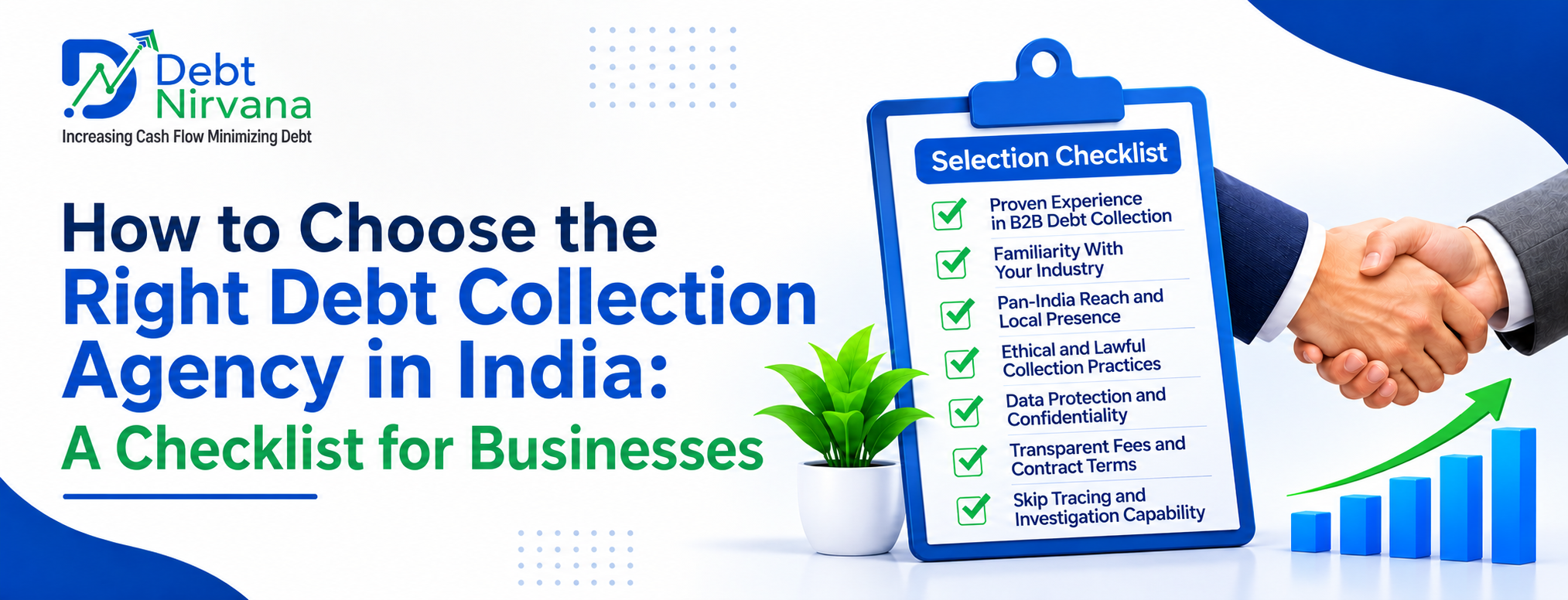
The 10-Point Checklist for Choosing a Debt Collection Agency in India
1. Proven Experience in B2B Debt Collection
Ask what share of the agency’s work is commercial debt, what ticket sizes it usually handles and how long it has operated. Recovering ₹50 lakh from a defaulting distributor is very different work from calling credit card holders. Ask for anonymised examples of cases like yours, and how they were resolved.
2. Familiarity With Your Industry
Every sector has its own payment culture. Pharma distribution, construction, IT services, logistics and FMCG each come with different credit terms, documents and dispute patterns. An agency that knows your industry can tell a genuine dispute from a delaying tactic faster, and speak to the debtor in terms they recognise.
3. Pan-India Reach and Local Presence
Your debtors are rarely in one city. Check that the agency can act where they are, including tier-2 and tier-3 towns. Ask whether field work is done by its own staff or by local partners, and who is accountable for it.
A local presence helps with in-person meetings and regional languages. It also lets the agency confirm whether a business still operates at its registered address.
4. Ethical and Lawful Collection Practices
How an agency collects matters as much as what it collects. Threats, abuse, public shaming or calls to a debtor’s family can lead to police complaints, damage your brand and weaken your position in court.
Ask for the agency’s code of conduct, and how it trains and monitors its collectors. The RBI’s new NBFC rules ban abusive or threatening language, excessive calls, public humiliation and misleading statements about the amount owed. These rules are written for lenders, but they are a sensible benchmark for any agency you hire.
5. Data Protection and Confidentiality
You will share invoices, contracts and contact details, and sometimes personal information about promoters or guarantors. The Digital Personal Data Protection Act, 2023 is coming into force in phases. Notice and consent, security safeguards and breach reporting apply from 14 May 2027.
Ask the agency whether it will sign an NDA, who can access your data, how the data is stored and whether it is deleted when the mandate ends. An agency that cannot answer these clearly is a risk you carry.
6. Transparent Fees and Contract Terms
Most commercial collection agencies in India use one of three fee models:
| Fee model | How it works | Best suited to |
|---|---|---|
| Contingency (success fee) | A percentage of the amount recovered; nothing is payable if nothing is recovered | Most B2B overdue accounts |
| Fixed fee | A set charge for a defined task, such as a legal notice or a skip trace | One-off, clearly scoped work |
| Retainer or hybrid | A monthly fee plus a lower success fee | Ongoing, high-volume receivables |
Rates depend on the age and size of the debt, the number of accounts, the debtor’s location and whether legal action is likely. Before you sign, get these in writing:
- The exact fee percentage, and whether it changes with the age of the debt.
- Whether the fee applies when the debtor pays you directly after the agency’s involvement.
- Who pays court fees and advocate charges if the matter goes legal.
- How you can end the contract, and what happens to accounts still in progress.
7. Skip Tracing and Investigation Capability
Some debtors simply disappear. Skip tracing is the work of finding them, along with their new address, contact numbers, related companies and current business activity. Ask the agency how it does this. Good answers include company filings with the Ministry of Corporate Affairs, GST registration status, public records and field verification.
A capable agency also checks whether the debtor can actually pay. A credit or business information report on the debtor tells you whether pursuing the debt, or going to court, is worth the cost.
8. Legal and Paralegal Support
A good agency knows when negotiation has run its course. It should guide you on the legal routes that fit your case:
- Legal notice: often the first formal step, and enough on its own to prompt payment in many cases.
- Cheque dishonour under Section 138 of the Negotiable Instruments Act, 1881: for bounced cheques, with strict deadlines for the demand notice and the complaint.
- MSME Samadhaan: micro and small suppliers can file delayed-payment cases under the MSMED Act, 2006. That Act caps payment terms at 45 days and entitles the supplier to compound interest on late payments.
- Civil recovery suit: filed before a commercial court where the dispute is commercial and above the specified value.
- Insolvency under the IBC: an option for defaults of ₹1 crore or more, used carefully because it affects the whole company.
A collection agency is not a law firm. Court work must be handled by advocates. Ask whether the agency offers paralegal support, works with experienced advocates, prepares case files and coordinates the legal stage for you.
9. Reporting and Transparency
You should never have to call the agency to find out what is happening. Ask for regular, account-level reports covering contact attempts, debtor responses, promises to pay and amounts recovered. Ask for a sample report and a single point of contact. Strong reporting also gives you an audit trail if the account ends up in court.
10. Respect for Your Customer Relationships
Many debtors are customers you still want to keep. Ask how the agency handles disputed invoices, whether it can negotiate installment plans or a debt restructuring, and when it escalates. The right partner is firm about payment but professional in tone. It protects the relationship wherever the debtor is acting in good faith.
Red Flags to Watch for When Hiring a Debt Collection Company
Walk away, or at least ask harder questions, if an agency:
- Promises guaranteed or 100% recovery. No honest agency can.
- Asks for a large upfront payment before doing any work.
- Offers a vague contract with no fee schedule or exit clause.
- Avoids explaining its collection methods or won’t share a code of conduct.
- Cannot be verified. Check its registration on the MCA portal, its GSTIN and a physical office address.
- Has no references, case studies or client feedback to share.
Quick-Reference Checklist: Questions to Ask a Debt Collection Agency
Use this table when you compare shortlisted agencies.
| Criterion | Question to ask | A good answer looks like |
|---|---|---|
| B2B experience | What share of your work is commercial debt? | Mostly B2B, with examples like your case |
| Industry fit | Have you recovered dues in our sector? | Named sectors and an understanding of your credit terms |
| Reach | Can you act where our debtors are? | Field coverage in those cities, with clear accountability |
| Conduct | What is your code of conduct? | A written policy, collector training and call monitoring |
| Data security | How do you protect our data? | An NDA, restricted access, and deletion when the mandate ends |
| Fees | What exactly will we pay, and when? | A written fee schedule with no hidden costs |
| Skip tracing | How do you find a debtor who has gone silent? | Specific methods, including MCA, GST and field checks |
| Legal support | What happens if negotiation fails? | Clear legal routes, with advocates in place |
| Reporting | How often will we get updates? | Regular account-level reports and a named contact |
| Relationships | How do you handle disputes? | Dispute resolution and settlement options before escalation |
How Debt Nirvana Helps Businesses Recover Commercial Dues
Debt Nirvana (RM Debt Nirvana Consulting Pvt. Ltd) is a commercial debt collection agency in India that works for businesses, from startups to large enterprises. Its debt collection services cover bad debt recovery, skip tracing, debt restructuring and paralegal support. Business information reports help you assess a debtor before you act.
The team operates from offices in Ahmedabad, Bangalore, Chennai, Delhi, Hyderabad, Kolkata, Mumbai and Pune. Debt collection mandates are handled on a “No Collection, No Fee” basis. Every account is assessed first, to tell a genuine cash-flow problem from deliberate non-payment, before the team chooses an approach.
Frequently Asked Questions About Debt Collection Agencies in India
How much does a debt collection agency charge in India?
Most commercial agencies charge a contingency fee, which is a percentage of the amount they recover. Some charge fixed fees for specific tasks, such as legal notices, or use a retainer for ongoing work. The rate depends on the age and size of the debt, the number of accounts and the debtor’s location. Always get the fee schedule in writing.
Is it legal to hire a debt collection agency in India?
Yes. Businesses can engage a third-party agency to recover genuine dues, provided it uses lawful methods. Harassment, threats or misleading claims can expose the agency, and possibly you, to complaints and legal action. Agencies that work for banks and NBFCs must also follow RBI rules on recovery agents.
How long does a debt collection agency take to recover a debt?
It depends on the debt’s age, the paperwork you hold, the debtor’s ability to pay and whether the case goes legal. Recent, well-documented dues are often settled through negotiation. Older or disputed debts can take longer, especially if court action is needed.
Can an agency recover a debt that is several years old?
It can still attempt recovery. But under the Limitation Act, 1963, a suit for recovery generally has to be filed within three years. A written acknowledgement of the debt by the debtor can extend this period. If your debt is approaching the three-year mark, act quickly and take legal advice.
What is the difference between a debt collection agency and a lawyer?
An agency handles pre-legal recovery: tracing the debtor, negotiating and agreeing settlements. A lawyer represents you in court. Many commercial agencies work alongside advocates, so the case moves into legal action smoothly if negotiation fails.
Will using a collection agency damage my relationship with the client?
Not if you choose well. A professional agency is firm about payment but courteous in tone, and it separates genuine disputes from deliberate non-payment. Many debtors pay once a structured, professional process begins. That can preserve the relationship better than repeated, frustrated follow-ups from your own team.
Conclusion
The right debt collection agency recovers your money without costing you your reputation or your customers. Use this checklist to test every shortlisted agency on B2B experience, reach, conduct, data security, fees, investigation, legal support and reporting. Treat any promise of guaranteed results as a warning sign.
Have overdue invoices that your team can’t recover? Speak to Debt Nirvana for an assessment of your outstanding receivables and the recovery route that fits each account.