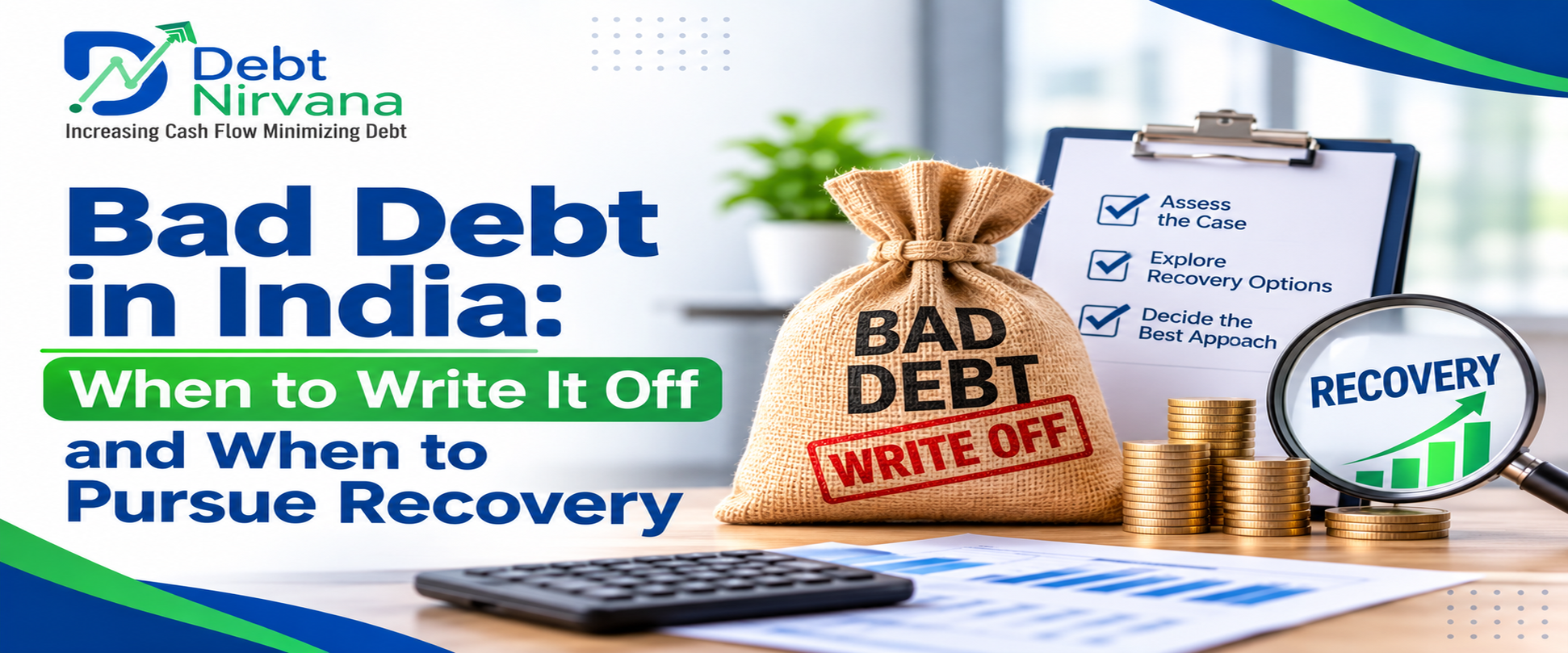

Bad Debt in India: When to Write It Off and When to Pursue Recovery
Every business that sells on credit eventually faces the same question about an old receivable: keep chasing it, or write it off and move on? Write off too early and you give up money you could have recovered. Chase too long and you spend time, legal fees and management attention on an account that was […]
Every business that sells on credit eventually faces the same question about an old receivable: keep chasing it, or write it off and move on? Write off too early and you give up money you could have recovered. Chase too long and you spend time, legal fees and management attention on an account that was never going to pay.
This guide gives finance heads and business owners a practical way to decide. It covers the signs that a debt has gone bad, a framework for choosing between write-off and bad debt recovery, and the tax and GST treatment in India. It also explains why writing off a debt in your books does not mean giving up the right to recover it.
What Counts as a Bad Debt?
A bad debt is an amount owed to your business that you no longer expect to collect. It usually starts as an ordinary receivable, moves into a “doubtful” category as it ages and payment looks less likely, and becomes “bad” once you conclude it is irrecoverable.
The distinction matters. A doubtful debt is a judgement call that you may provide for in your accounts. A bad debt is one you formally write off. The two are treated differently for tax purposes, as explained below.
Warning Signs That a Receivable Is Turning Bad
- The invoice has crossed 90 or 180 days with no payment and no clear reason.
- The customer has stopped answering calls and emails, or keeps making promises to pay that it doesn’t keep.
- Cheques from the customer have bounced.
- The customer has moved premises, shut a branch, or changed its name or management.
- Other suppliers report the same customer is not paying them either.
- The company’s filings on the MCA portal are overdue, its status has changed, or insolvency proceedings have started.
One sign on its own may mean little. Several together usually mean the account needs a decision now, not at year-end.
Write Off or Pursue Recovery? A Decision Framework
No single rule fits every account. Weigh these factors together:
| Factor | Points toward pursuing recovery | Points toward writing off |
|---|---|---|
| Amount | Large enough to justify recovery costs | Small relative to the cost of pursuing it |
| Age and limitation | Well within the three-year limitation period, or extended by a written acknowledgement | Time-barred, with no acknowledgement or part payment to revive it |
| Debtor’s ability to pay | The business is still operating, with assets or revenue | Shut down, with no assets and no one to pursue |
| Documentation | Signed purchase orders, invoices, delivery proof and a reconciled ledger | Verbal orders, disputed deliveries or missing records |
| Legal leverage | A bounced cheque, a personal guarantee, or MSME supplier status | No special remedy; only an ordinary civil suit |
| Relationship | The customer still matters and may pay with a restructured plan | No future business, and the debtor is acting in bad faith |
Before deciding, check the debtor’s current position. A credit or business information report shows whether the company is still trading, whether it has charges registered against its assets, and whether other creditors have taken action. That tells you whether a judgment or award would actually be collectable.
Recovery Options Before You Write Off
If the framework points toward recovery, choose the route that fits the debt:
- Negotiated settlement or restructuring: a payment plan, or a partial settlement for prompt payment, often recovers more than litigation, and faster.
- A professional collection agency: a bad debt collection agency in India working on a contingency basis adds structure and outside pressure, at little upfront cost.
- Legal notice: a formal legal notice for payment recovery puts the debtor on record and sets a deadline before court action.
- Section 138 complaint: if the customer’s cheque bounced, a cheque bounce case adds criminal liability to the pressure.
- MSME Facilitation Council: registered micro and small suppliers can file a delayed payment complaint and claim compound interest.
- Commercial suit or insolvency: after pre-institution mediation for claims of ₹3 lakh or more, or insolvency proceedings for undisputed defaults of ₹1 crore or more.
- Selling the debt: some businesses sell old receivables to a debt purchaser for an immediate, discounted payment, and move the recovery effort off their books.
You Can Write Off a Debt and Still Recover It
Many businesses assume that writing off a debt ends the matter. It doesn’t. A write-off is an accounting and tax decision. It does not cancel the debtor’s legal obligation to pay. You can write off an old receivable in your books, claim the tax deduction, and still hand the account to a recovery agency or pursue it legally, provided the limitation period has not expired.
If you later recover money on a debt you have written off and claimed as a deduction, that amount is taxable as income in the year you recover it. This is often the most practical approach: clean up the balance sheet, take the deduction, and keep pursuing the debt on a contingency basis.
Tax Treatment of Bad Debts in India
The Income-tax Act, 2025 replaced the Income-tax Act, 1961 from 1 April 2026. For tax year 2026-27 onwards, the deduction for bad debts is in Section 31 of the new Act. It was previously Section 36(1)(vii) of the 1961 Act. The core conditions carry over:
- The debt must have been counted as income earlier. A trade receivable qualifies because the sale was included in your income when you invoiced it. A loan or advance to a third party generally does not, unless lending is your business.
- It must be written off as irrecoverable in your books in the year you claim the deduction.
- You do not have to prove the debt is actually irrecoverable. Since the 1989 amendment, the Supreme Court and tribunals have consistently held that a genuine write-off in the books is enough. Keep your recovery efforts and correspondence on file anyway, in case the tax officer asks.
A provision for doubtful debts is different. For most businesses other than banks and certain financial institutions, a mere provision is not deductible. Tribunals have held that it cannot be claimed as a general business expense either. The deduction comes only when the debt is actually written off.
Companies that follow Ind AS also recognise expected credit losses on receivables under Ind AS 109. That is an accounting estimate, separate from the tax write-off. Discuss the timing of both with your auditor.
What Happens to GST on a Bad Debt?
This is where many businesses lose money twice. When you issued the invoice, you paid GST on it to the government. If the customer never pays, GST law gives you no general refund of that output tax just because the debt has gone bad.
Issuing a credit note to reduce your liability is not a simple fix. After the 2025 amendments, the supplier’s tax adjustment on a credit note depends on the buyer reversing the corresponding input tax credit. A defaulting or closed customer is unlikely to cooperate.
On the buyer’s side, a customer that has not paid you within 180 days of the invoice must reverse the input tax credit it claimed on that invoice, with interest. That rule doesn’t put money back in your hands, but it is a useful point to raise in recovery discussions with a customer that is still registered and operating.
The practical result: on a written-off debt you have lost both the sale value and the GST you paid on it. That is one more reason to make a serious recovery attempt before giving up on a large receivable.
How to Reduce Bad Debts in the First Place
- Check a new customer’s creditworthiness before extending credit, and recheck large accounts every year.
- Set a credit limit for each customer, and stop supply when it is reached.
- Put payment terms, interest on late payment and a jurisdiction clause in every contract or purchase order.
- Take security where the exposure is large: post-dated cheques, a bank guarantee or a personal guarantee from the promoters.
- Review your ageing report every month, and escalate any account that crosses 60 or 90 days.
- Act early. Recovery rates fall as debts age, and limitation runs out at three years.
How Debt Nirvana Helps With Bad Debt Recovery
Debt Nirvana’s bad debt recovery service works on accounts that internal teams have given up on. It first assesses whether a debtor has a genuine cash-flow problem or is deliberately not paying, and then chooses the approach.
For businesses that would rather convert old receivables into cash now, Debt Nirvana also offers debt purchase. And before you extend fresh credit, its business information reports help you avoid the next bad debt.
Frequently Asked Questions About Bad Debts
When should a business write off a bad debt?
When recovery is unlikely or would cost more than it would bring in: the debtor has no assets, the debt is time-barred, or your documents are too weak to support a claim. For large amounts, try a structured recovery or get a recovery assessment first.
Can I recover a debt after writing it off?
Yes. Writing off a debt in your books does not cancel the debtor’s obligation. You can keep pursuing it until the limitation period expires. Any amount recovered after you claimed a tax deduction is taxable in the year of recovery.
Which section of the Income-tax Act allows a bad debt deduction?
Section 31 of the Income-tax Act, 2025, for tax year 2026-27 onwards. For earlier years, the deduction was under Section 36(1)(vii) of the Income-tax Act, 1961. The debt must have been included in income earlier and written off as irrecoverable in the books.
Is a provision for doubtful debts deductible?
For most businesses, no. Only an actual write-off of a bad debt is deductible. Special rules apply to banks and certain financial institutions.
Can I get back the GST I paid on an invoice that was never paid?
Generally not. GST law does not provide a general refund for bad debts. A credit note is possible in some cases, but it now depends on the buyer reversing its input tax credit. Take advice from your GST consultant on your specific invoices.
How old can a debt be and still be recovered legally?
A suit for recovery generally has to be filed within three years from when the payment fell due. A written, signed acknowledgement of the debt or a part payment by the debtor within that period starts a fresh three-year period.
Conclusion
Writing off a bad debt and pursuing bad debt recovery are not opposites. The right decision depends on the amount, the age of the debt, the debtor’s ability to pay and the strength of your documents. Often the best answer is both: write the debt off for tax and accounting, and keep recovering it through a professional partner.
Holding receivables you’ve almost given up on? Contact Debt Nirvana for an assessment before you write them off.